MOIRAJO
  • Weekly Devotionals
  • Weekly Message
  • Sermon Podcasts
  • Links
  • Contact

Discipleship: Being Transfigured

2/22/2023

0 Comments

 
Picture

Exodus 24:12-18     Matthew 17:1-9
 
        A sign of the times:  I recall when Forrest and I were on vacation in one of the most beautiful places on earth, the Grand Canyon.  We went out to eat at a cozy little restaurant.  Roses graced every table.  Beautiful music enveloped us. But as I looked around, I was stunned.  The place was filled with couples, and most of them, instead of talking with each other, gazing lovingly into the eyes of their date, where instead busy on their phones.  Electronics have weaseled their way even to the dinner table.  Have you ever seen this?  Sadly it’s becoming a more common sight at the dinner table both in and out of the home, in cars, gyms or stores.

        Most parents I know try to consciously monitor iphone use, television, video games, electronics and social media was because we want to limit the messages our children hear from popular culture.  Messages that promote materialism, greed, and violence.  Of course, children are exposed to everything eventually.  But we hope that if the messages came in small doses, maybe they would have less power.  What children hear and see in their parents has the most power and influence over them.  Our hard work, our demonstrations of sacrifice, our love and care. But there are many other messages out there that can have an effect on our lives.
​
        What messages and voices do you listen to?  What TV or cable programs fill your day? What influencers on Instagram or TiKTok do you follow?  Secular culture tells us that we need certain things to be happy:  lots of money, a beautiful body, a successful career, bigger houses, fancy vacations and the latest technology.  In politics we hear conflicting voices about every possible issue, from the environment to immigration, health care and the role of government.  What voices do you listen to?  What messages do you believe?   


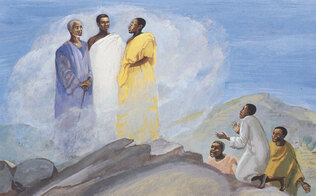
 In the passage from Matthew we heard today, a voice told the disciples to listen to Jesus.  Jesus had taken three of his disciples up a high mountain.  And while they were there, Jesus was transfigured before their eyes.  His face began to shine and his clothing became dazzling white.  Great prophets of the past, Elijah and Moses, appeared and spoke with him.  A cloud overshadowed them and a voice said, “This is my Son, the Beloved, listen to him!”

        We heard a similar message when Jesus was baptized.  When Jesus came up out of the water, the heavens opened and a voice from heaven said, “This is my son, the Beloved, with whom I am well pleased” (Matt. 3:16-17).  Today’s story comes in the middle of the gospel, and the voice announced the same thing, with one addition: “Listen to him!”  This message came at a crucial time, because Jesus was just starting to tell his disciples a message they didn’t want to hear.

        Up until this point, Jesus had been healing, casting out demons and teaching that the Kingdom of Heaven was at hand, was right there in their midst.  This was both comforting and exciting, the idea that God’s power was once again active on the earth, and God’s reign of justice was near.  Who could resist such a message?  But in the middle of his ministry, right before today’s story, Jesus asked the disciples who they thought he was. And when Peter said, “You are the Messiah,” Jesus began to tell them that he was going to suffer and be rejected and killed.

        Peter protested and told Jesus, don’t say such things.  In Peter’s mind, bad things were not supposed to happen to the Messiah.  But Jesus rebuked Peter and went on to tell him that “those who want to save their lives will lose them” (16:25).  That kind of message is hard to hear.  But this was a turning point in Jesus’ ministry.  Now he would begin his journey to Jerusalem where he knew he would die.     

        Peter couldn’t listen to him.  He had just confessed that Jesus was the Messiah, but he didn’t really understand what that meant.  And now on the mountain, he again didn’t know how to respond.  The whole experience was terrifying, so he blurted out a suggestion that they build three little structures right on the mountain, one for Jesus, one for Elijah and one for Moses.  But this holy moment did not call for words or plans of action.  It was a vision of who Jesus was and is.  Suddenly they could see on the outside of Jesus what was inside – God’s power and glory shining through.  The disciples were faced with the transforming power of God at work in Jesus.     

        “This is my son, the beloved.  Listen to him.”  That’s God’s message to us. Who do you listen to?  Your husband or wife?  Your parents, or children?  Your friends?  Fox News?  NPR?  It’s not easy to hear Jesus with all these voices vying for attention.  It’s easier just to listen to the adds and go shopping, or just do what our boss or spouse tells us to do.  But when we listen to Jesus, and walk with him, we find life.  We too become transfigured-changed – our true selves, our Christlike nature, becomes visible for others to see.

This Wednesday marks the beginning of Lent, the period of 40 days before Easter.  This is an important time in the life of the church.  During Lent we follow Jesus on the road to Jerusalem, preparing for what is to come during Holy Week, the death and resurrection of Christ.  The message of Jesus’  transfiguration today is a gift of light before we enter the trials and darkness of Lent.  Our scriptures call us to make Lent into a transfiguring time. We frequently say we will give up something for Lent, like candy, meat, or dessert.  How about we deepen our faith life through other tried and true practices?  How can we transfigure ourselves over the next six weeks before Easter?

        We start by asking ourselves, how do we listen to Jesus? How do we listen to someone who lived thousands of years ago and is no longer here in bodily form?  We can start by reading about him in the Bible. 

Every Christian who is able to read, should read the gospels.  Matthew, Mark, Luke and John are the first four books of the New Testament, and they each tell the story of Jesus’ life.  If you have never read one of them all the way through, I encourage you to do it during Lent this year.  If you’ve read them all already, you can read one again.  There’s always something new to discover.  You are invited to join our Bible Study on the “I AM” statements of Jesus during Lent.  We meet on Wednesdays at 12:30 on zoom.  Nothing would delight me more than a request to hold a second session during the week.  Just speak up and let me know.

Another way to listen to Jesus is through prayer.  And if you want help and guidance with that, or just some company when you pray there are many in this congregation that will step forward and be willing to pray together.  Any takers on this?  Again, nothing would make me happier than a Lenten prayer group!

Finally, one more way to listen to Jesus is by listening to other people of faith to hear what they think.  You can listen to sermons or engage in conversations with others.  Listen to religious podcasts or watch YouTube sermons, meditations, bible studies. Binge watch the Chosen, a multi-year series on the life of Jesus. This Lenten season, several local Presbyterian churches will be having Sacred Cinema Film Fests on Wednesday evenings.  We’ll watch a clip of a movie and prayerfully discuss the spiritual message of the clip.  Just join on via zoom.  Or you can read books dealing with faith issues.  Some of us are reading Wholehearted Faith by Rachel Held Evans  - you are invited to read along and join the discussion the week after Easter. There will also be Lenten devotions sent out by email once a week: make sure to read them daily.  Maybe Jesus will speak to you through their words.

By participating in worship, spiritual activities, we aim to change, like what’s been happening at Asbury Theological Seminary in Kentucky.  Since February 8, there has been nonstop worship. Fueled by Instagram and TikTok, people from all around the country have flocked to the university’s chapel, to sing, to pray to repent, some weeping, giving testamonies, being changed.  Called the Asbury Awakening, there is no doubt spiritual renewal is taking place.  Look it up on social media.  Wouldn’t it be great if we could get a taste of that here in our church?

 By listening to Jesus through the scriptures, devotionals, prayer, and deeds of service may we be changed to the vision God has for each of us, and may we begin to change the world into the kingdom of heaven here on earth. Remember the saying:  you might be the only Bible others may read. 

So let us heighten our practice acts of fasting, mercy, forgiveness, kindness during Lent and make it a permanent practice in our religious walk of faith. As we read earlier this month from Isaiah, let us not just fast from food, but from hurtful deeds, harsh words and vengeful attitudes.  May we bring all these changes to others by listening to them, helping them, being in fellowship and caring relationships.  Listen to him.  May that command be the mantra that guides us in our Lenten travels.  May the transfiguring, transforming light of God be upon us, in us and shine through us, in word and deed, for all to see and give glory to our God in heaven.  Amen.     


0 Comments

Discipleship:  Conflict and Community

2/15/2023

0 Comments

 
Picture


Deuteronomy 30:15-20    1 Corinthians 3:1-9   Matthew 5:33-37

With Valentine just two days away, here is some wisdom from the mouth of babes regarding this day of celebration.

You got to find somebody who likes the same stuff. Like if you like sports, she should like it that you like sports, and she should keep the chips and dip coming." Alan, age 10

"No person really decides before they grow up who they're going to marry. God decides it all way before, and you get to find out later who you're stuck with." Kirsten, age 10

" Tell your wife that she looks pretty even if she looks like a truck." Ricky, age 10

Valentine’s Day: Over 18 billion dollars will be spent on greeting cards, candy and flowers, not to mention nights out on the town and jewelry.  All this to demonstrate love both for partners and also for family and friends.   Add  todays Super Bowl activities and we have the makings of a three-day frenzied food fest.

While Valentine’s Day has pagan roots, the church has remembered an original 3rd Century Valentine, a priest or Bishop who was martyred on February 14 for marrying soldiers – an act which was illegal according to Roman law.  He also wrote to prisoners and cared for their needs at the time.  While we will enjoy the cards, chocolates, flowers and special dinners, let’s  take in account the religious roots of the holiday.  Our St. Valentine shows us different dimensions of love. A love that is our source of life and transcends ordinary giving and invites us into a love we are called to live day in and day out.   While our lessons today do not mention love, love is the cornerstone of what Moses speaks during his final speech to the Israelites.  Love is the cornerstone of what Jesus speaks of when he speaks of dealing with anger and reconciliation as well as about the roots of lust and divorce. Love is what Paul is aiming as he admonishes the squabbling in the church at Corinth.

As disciples, love must be our focus.  Love like we have been learning about discipleship, however, is not easy.  Whether in a relationship, a family, church community or a larger society, love is often challenged by conflict, misunderstandings, hurts, miscommunications.  Conflict is simply a part of life.  Even in love, hurts will arise. Misunderstandings and miscommunication threaten our connections of love.  As disciples, our job is to create healthy relationships, even in the midst of conflict.

       In our prayer of confession, we hear from Deuteronomy some of Moses’ last words before he died.  The Israelites had been wandering in the wilderness for 40 years and were looking forward to entering the Promised Land.  Moses knew he wouldn’t be able to go with them, so he delivered these words from God, “I call heaven and earth to witness against you today that I have set before you life and death, blessings and curses.  Choose life so that you and your descendants may live…” 

According to Deuteronomy, we find life by walking in God’s ways, and observing God’s commandments (vs. 16).   It’s about choosing the “yes” to God.  It’s about loving and being aware and connected to God and God’s creation, being aware and connected to our true selves, and being aware and connected to other human beings.  It’s about practicing our faith, and walking mindfully through life, in harmony with God’s ways. 

Love and blessings are a good and needed foundation for the hard sayings we heard today from Jesus.  While Jesus speaks of the holiness to which disciples are called, his words here are not meant to be taken literally. Otherwise, the streets would be full of mangled faces and hacked off limbs. 

Jesus said these things because he wants us to understand and fulfill the spirit of the law, which is love.  Jesus wants us to live well in community. So, Jesus speaks in hyperbole, a common Semitic trait to get a point across.  According to Jesus, God’s law goes beyond simply behaving well. It is more than a Valentine card.  The purpose of the law is to guide us into the ways of God.  And that involves more than behavior.  It involves what’s in our hearts. At its root it’s about life that embraces the fullness of love.
So, Jesus gives some examples.  The law says, “You shall not murder.”  But if you are angry with someone and you insult them, aren’t you murdering them in spirit, shutting them out, and writing them off as worthless?  The law teaches us not to kill.  But in the Kingdom of God, discipleship is more than simply avoiding murder or physical harm to others.  It’s about treating others with dignity and respect even if there is a difference of opinion.  

The law also says, “You shall not commit adultery.”  That was based on the idea that you shouldn’t steal something that belonged to another man -- in this case his wife. But Jesus asks more of us.  When you lust after someone, you are looking at them as an object to be taken and used for your own pleasure or desire.  Jesus asks us to honor people as real human beings with their own feelings and needs and honor their commitments as well as our own. That’s discipleship, living well in community.
Divorce is another example.  Writing a certificate was legal, but it still allowed men to divorce their wives for frivolous reasons.  Back then a divorce could ruin a woman’s life because women had no way to support themselves.  They were dependent on men, and it was hard for a divorced woman to re-marry.  So, Jesus says, consider the needs of women, and honor your commitments to care for others.  That’s discipleship:  living well in community.

Again, according to the law, a person’s oath or vow was binding depending on how closely it was associated with the name of God.  Jesus said, skip the oath-taking and just tell the truth.  If you say “yes,” mean yes.  If you say “no,” mean no.  It’s about whether or not people can trust you.  Be trustworthy.    That’s discipleship, living well in community.

Jesus took the law to a new level, beyond mere rules and rituals, to focus on relationships, our relationship with ourselves, with each other, and with God.  Jesus is talking about life in community as the fullest expression of love. If you have integrity in yourself, honor and respect God and your neighbor, then you will naturally fulfill the law of Christ.   It means we shall choose life and love to the fullest.

The Apostle Paul puts it to us this way:  are we ready to be fed the solid food, to be mature Christ-followers?  The jealousy and quarreling Paul witnessed among the Corinthians was unacceptable to the teachings of Jesus, and the law of life God transmitted to Moses.  People in Corinthians were choosing factions.  “I like elder X over Elder Y” “Apollo is so much nicer than Paul, and so on. Paul says all this favoritism is nonsense. We must work together, different tasks, all important in building up the kingdom of God – which Paul describes in these terms:” You are God’s field”  “you are God’s building.”  The directives show us how to work together for the greater good.  That’s why rupture in connection – through anger, jealousy, quarreling – is a form of being cursed and causes catastrophes throughout all systems – with a partner, in a family, in a church, in our society, our planet, our every universe. Life is connected, at all levels. 

Damar Hamlin the Buffalo Bills quarterback that suffered a cardiac arrest in the midst of the game on January 2  said  recently as he looked back on the tragedy he faced:  “Everyday I am amazed that my experiences could encourage so many others… encourage to pray, encourage to spread love, and encourage keep fighting no matter the circumstances…(in) .my vision I was about playing in the NFL and being the best player I could be.   But God’s plan was to have a purpose greater than any game in this world.’  God who brought good out of a potential tragedy, acts in exactly the same way with us.  In the hands of God, our difficulties, conflicts and troubles turn into blessings and reconciliation, stronger bonds than ever.  If we only surrender to discipleship.

What conflicts are brewing in our hearts?  What tensions tear at our church community? What problems plague our society?  Conflicts are inevitable, disagreements are common, misunderstandings part and parcel of human life.  The issue isn’t to ignore these situations, to hide them away, but live through and deal with such situations so that love prevails, forgiveness reigns, tolerance and forbearance forge the foundation of our communal life. That’s the task of discipleship for us.  We find blessings in spite of struggle, we discover grace in the midst of disagreements when we seek to follow the principles of life and love that Moses, Paul and Jesus points us too.
​
So, friends, when we celebrate Valentine’s Day, let us choose to follow Jesus’ teaching and work to resolve the conflicts in our midst.  Because when we choose love, we choose consciously to forgive, and to turn away from anger.  Let us build the kind of relationships, although imperfect, can stand the test of love.  Let us be disciples of love, and build communities of true love, that shine, warts and all, for all to see and be inspired.  Amen


0 Comments

Discipleship:  Fulfilling God's Fast

2/8/2023

0 Comments

 
Picture
Matthew 5:13-20; Isaiah 58:1-9a, 

Want to look like Beyonce? Jennifer Aniston? Rihanna? Jennifer Lopez? Jason Mamoa aka Aquaman? Chris Hemsworth aka Thor? Jake Austin?  It’s time to do a 5:2, a diet made popular by Dr. Michael Mosey’s “The Fast Diet” book. The catch is the diet is based on eating pattern of medieval monks and nuns when food was often scarce. They ate simple meals five days a week – fasting (in most cases eating one basic meal of no more than 600 calories) twice a week: on Wednesdays and Fridays. So, what’s your favorite diet?  Intermittent Fasting?  Keto? Mediterranean?  Or my favorite, the cookie dough diet! Or how about the “seafood diet?”  See food, and eat it!

Who would believe that fasting has become fashionable?  In the endless pursuit of the elusive size 000, people are paying thousands of dollars a week to visit health spas where they go without food. One spa in California, is booked months in advance with a clientele that includes celebrities Ben Affleck and Courtney Love. A Venezuelan beauty queen has had plastic mesh sewn to her tongue in her pursuit to stay thin. Fashion designers and mortgage brokers have joined the fasting trend - subsisting on apple-celery cocktails, herbal teas, laxatives, bee pollen, blended soups, and water mixed with squeezed lemons, Celtic Sea salt, and honey. Yummy.

One nutritional consultant organizes four-day fasting weekends for women that include motivational trips to a fashionable department store, to "remind them what it's all for."
Let’s get it straight: Fasting is not about fashion. It was about repentance, purification, preparing for rebirth, or a new stage in life.  Jesus fasted before beginning his public ministry.  Moses fasted before he received the 10 commandments. Daniel fasted and was blessed with wisdom. Esther called for a 3 day fast for all the Jews in her city, who were spared annihilation. Hannah could not bear a child and she fasted. God heard her plea and the prophet Samuel was born.  God called Paul and shared the assignment for his life during a strict fast. Peter was fasting when God gave him a new revelation and called him to take the gospel to the Gentiles. King Solomon fasted and God greatly increased his wealth and wisdom (Kings 3:10-13). After hearing Jonah’s dire predictions, the King of Nineveh declared a fast, even unto the animals, and God diverted the punishment. People may fast for fashion, but fasting is a key tool to spiritual growth and transformation.

Last week, we heard Jesus most famous teaching, the beatitudes – teachings that turn blessing on its head, teaching that causes us to pause, wonder what it means to be blessed in this world of ours.  For the next few weeks, we will hear Jesus expand on his teachings, teachings based in the law expressed in the beatitudes. Teachings that make us reach deep into ourselves, throw some conventional religious concepts on their head -- teachings to wake us up – and understand what it means to follow Jesus.  To be light. To be salt. To be righteous.
Jesus builds on Isaiah’s bold teachin
gs that we heard today. Fasting was part of Jewish life and Isaiah spells out what is acceptable fasting.  What does fasting do for us that is so important?

There’s a story about a wealthy businessman who went to a monastery for a retreat. He wanted to get closer to God. He was brought before the abbot of the monastery to seek spiritual direction. The abbot asked the man if he would like a glass of water. When the man responded with a “yes”, the abbot began to pour him some water. The abbot poured and poured until the water reached the very tip of the glass; but he didn't stop! Instead, he kept pouring and pouring so that the water overflowed ran onto the table; and drenched the expensive suit which the man was wearing.

Jumping up angry, the man yelled at the abbot, “What are you doing? Look at what you did to my suit!” Turning to the man, the abbot said, “You are like this glass of water. You are so full of yourself and of concerns for riches and other anxieties of the world. You are completely full. There is no space for you to hold anything else inside. There is no room for God to come in. Before God can come in, you must empty yourself and make room for Him to enter.”

We are that glass. Fasting, followed correctly, is a tool that we use to detach ourselves from the cares and concerns of this world; and from our own ego and selfish desires. It’s not about how long we fast, how we fast, but that we fast. Fasting isn’t just for lent, Ash Wednesday, or Good Friday. Fasting is part of our regular living. Through fasting, we encounter all the reasons we use food as a way to distance ourselves from our sacred souls – how we hide behind that mars bars and bag of chips to avoid encountering people and encountering God.

True fasting involves abstinence from everything that distances us from God. By emptying ourselves of sin, of gossip, of hate, vanity -- we are cleaned, healed to our right minds. Fasting in this manner, makes us light in the world and salt of the earth – an earth that has lost its flavor through gluttony of attachments to money, power, a false sense of beauty and life purpose.

In the face of the onslaught of the “fast food” of the mind, body and soul we feed upon daily:  Jesus awakens us, tells us that our true purpose is that we are salt and light in the world, and that our righteousness must exceed that of the scribes and Pharisees. The scribes and Pharisees were good people.  They studied the scriptures and tried to follow them with dedication and zeal.  Yet they failed.  The words of the prophet Isaiah are blunt.  They, like their ancestors, comrades of Isaiah, observed the fasts.  They didn’t cheat with extra cookie or slice of bread.   They made their offerings at the temple as prescribed. By Jesus’ day, the Pharisees fasted up to twice a week, Mondays and Thursdays, (Luke 18: 9-14).  Jesus condemned the Pharisees for disfiguring their faces – with ash and dirt -- to alert the rest of the world that they were fasting (Matt 6:16-18).  So, we can fast, and fast well, for all the wrong reasons: like to show off our will power or our slimmer body. If that’s the goal, then the true fast has failed.
It’s time we regained fasting and took it seriously. It is good to fast, even a basic fast.  As a people used to getting what we want, when we want it, both Jesus and Isaiah make it clear that a good fast, an acceptable fast, brings healing, and restoration within ourselves even into our community.

Isaiah raises the following questions:  is a fast a true fast if one continues to oppress their workers while abstaining from food or drink? Or if we quarrel? Or fight? Isaiah says, and Jesus also teaches, that being able to control the hunger sensations of the body means nothing if we are unable to control the desire to be #1, to be in control, to lord over others, to turn away and ignore the hungry, the homeless, the poor – even to avoid our family in need.   What does throwing ash on our heads and wearing sackcloth prove, if we continue to speak evil, gossip, falsely accusing others? 

A Godly fast is a fast from greediness. A fast that curbs our tongue from slanderous speech.  A fast from the gluttony of gadgets we indulge ourselves. Maybe instead of food, we need to fast from pride.  Maybe instead of food, we need to fast from TV, the radio, the computer, the smart phone:  and spend that time with someone who is lonely.  Maybe instead of food, we can fast from eating out, and give that money to a charity. As we enter Black History Month, it’s a time for us to collectively fast from prejudice and racism, and advocate for reconciliation, just practices, and alliances that bridge the races and bring harmony to our fractured society.

  God’s acceptable fast asks us to stop feeding our own wants and desires and redirect our energies to feeding the hungry and helping the afflicted. That is how our light shines in the world. We fast for compassion and connection -- for a world for whom fasting is not an option, but an imposed, inescapable reality. 

We need to empty the glass so we can fill it with God.  We get plugged in. Our light shines.  We act like salt – an essential ingredient, a preserving agent, adding flavor and variety to life on earth.  Those dry and barren aspects of our souls?  They become watered by God’s spirit. Our bones become strong – the frame upon which we build a life -- becomes steady and firm. A Godly fast fixes those broken places, areas in our psyche that are breached by sin and bad habits. Through us God can rebuild the world around us.   We create a foundation for others to build on for generations beyond us. Now that’s a fast.
​
It doesn’t matter how each of us fasts.  But fast we should. Whether it is abstaining from meat, from coffee, sugar – a water fast, a juice fast, a fast from electronics, a fast that returns resources to the hungry, needy, holds back smart-alecky responses. Fast – in way that is acceptable between you and God. If only Beyonce, Jennifer Aniston - Gwyneth Paltrow - Phillip Schofield knew the power of the true fast. We can seek that size 0 – but a size 0 in gossip, envy, hoarding, ignoring the plight of the poor. Fast – and let our glass be filled with the Holy Spirit – creating a space for light and salt  --  to bring healing through your righteousness to restore and repair, and fulfill God’s word in our midst. Amen.


https://www.preachingtoday.com/illustrations/2021/june/black-homeowners-appraisal-doubles-after-white-friend-poses.html
http://www.preachingtoday.com/illustration Peter Larson, "Fashionable Fastingthe PRISM E-pistle (9-3-03); submitted by Marshall Shelley, Wheaton, Illinoiss/2003/september/14600.html
​

0 Comments

Discipleship: Being Blessed

2/1/2023

0 Comments

 
Picture
​
Matthew 5:1-12; Micah 6:1-8
 
        Adapted from “Blessed” Rev. Debra Given, the Presbyterian Church in Leonia, January 30, 2011
* credit to Brian Stoffregen, “Exegetical Notes,”  CrossMarks Christian Resources, at http://www.crossmarks.com/brian/matt5x1.htm.     
                https://www.cnn.com/2023/01/21/us/william-barber-christian-nationalism-blake-cec/index.html
https://www.nytimes.com/2022/03/09/opinion/william-barber-selma.html?login=email&auth=login-email
 
        All month long our texts have led us to reflect on what discipleship means.  Discipleship we have discovered, is a Journey to Jesus, a journey with Jesus.  Discipleship teaches us to expect the unexpected.  Discipleship reminds us we often find ourselves taking an unpopular stance, where we are alone, taking the narrow path.  Discipleship calls us to leave behind the past, let go of the familiar and follow Jesus into the unknown.  Discipleship is not for the faint of heart. Discipleship means picking up our cross, being willing to sacrifice, finding joy in the midst of the challenges and opportunities life brings us.  Today we learn that discipleship is also about blessings. 
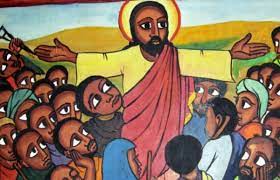
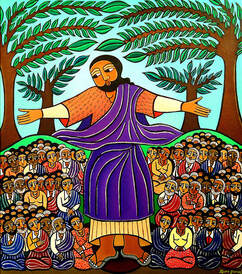
In today’s gospel, we find Jesus on a mountain, laying the foundation of gospel living for his listeners.  This reminds us of the time when Moses received the ten Commandments on Mt. Sinai.  But instead of commandments, in Matthew we get three chapters of Jesus’ teaching, and we call it the Sermon on the Mount.  It contains some of the most famous and challenging teachings of Jesus.  We’ll be reading a parts of this sermon over the next few weeks, but I recommend you read through the whole thing at home, chapters 5 through 7, in the gospel of Matthew. 

        Today we read the beginning of the sermon on the mount, commonly called the Beatitudes, or blessings, in the first 12 verses.  Now in American culture, we think of blessings as good things that happen to us, or that we have.  To “count your blessings” means to list all the good things in your life.  And we might say things like, “I’m blessed to have my own home and a nice car and good job.”  Or “I’ve been blessed with good health.”  We use the word “blessed” to mean lucky or fortunate. 

        But that’s not necessarily how Jesus used the word.  Being blessed is not about having a bunch of cool stuff or being happy because things are going our way.  In the Beatitudes, Jesus pronounced blessing on the poor and downtrodden.  They are blessed because God’s favor is with them.  They may feel miserable now, but they are not forgotten.  God is paying attention and is with them.  And in God’s kingdom, everything will be reversed.  Humility, meekness, sorrow, inner poverty and purity are not usually things the world seeks after.  But in the Kingdom of God, those who have these qualities will be honored and blessed.

        The Beatitudes have eight blessings, and they are divided into two groups.*  The first group is for those who don’t feel blessed in this world.  The poor in spirit are not just poor financially but are also people who have lost reason to hope.  Those who mourn or grieve find no reason for joy in life.  The meek include not just the humble or gentle, but also those who have been walked on and denied their fair share on this earth.  And those who hunger and thirst for righteousness are also those who are the victims of unrighteousness – those who are abused or trafficked, those who live under corrupt or oppressive governments, victims of prejudice, greed and war. 

        Rev. William Barber II, the minister considered most akin to Martin Luther King Jr. in our day, called a modern-day Moses in a recent NY Times article, is a blessed person according to kingdom values.  If you don’t know who Rev. Barber is, I recommend you look him up. He’s an amazing man, a prophet for our times.

Rev. Barber is riddled with illness and physical pain.  Suffering from a painful form of arthritis, it hurts him just to walk, as he does with an aide and a cane. He lives with constant, chronic physical pain every day. That has not stopped him from being an outspoken national leader, co-chair of the Poor People’s Campaign: A National Call for Moral Revival, one of the nation’s most sustained and visible anti-poverty efforts. He has created a third mode of activism called “fusion politics.” It creates political coalitions that often transcend the conservative vs. progressive binary. Rev. Barber finds inspiration for his activism from Dr. Martin Luther King’s speech in 1968:

“I remind you that starving a child is violence,” “Suppressing a culture is violence. Neglecting school children is violence. Punishing a mother and her child is violence. Discrimination against a working man is violence. Ghetto housing is violence. Ignoring medical needs is violence. Contempt for poverty is violence. Even the lack of willpower to help humanity is a sick and sinister form of violence.”  King ended the passage by saying that “the problems of racism, poverty and war can all be summarized with one word: violence.” Barber is about creating cross-racial, cross-religious, cross-generational coalitions as the only way to confront this violence. We have tragically seen this happen again in the recent and brutal death of Tyre Nichol in Memphis on January 10, due to a brutal beating he received while in police custody.

        The protests of Tyre Nichols’ death speaks to our cries for God’s blessing of comfort and righteousness in the midst of tragedy.  We also see Rev. Barber as such a man who hungers and thirsts for kingdom righteousness.  I don’t know anyone who would call him blessed, in the sense that he was fortunate or happy or pain free.  But he has found blessing in God’s kingdom, because he is faithful to Jesus’ cry that God’s will is done on earth as it is in heaven.  People who have been denied justice and their share of blessing in this world will receive mercy and justice, peace and love, because when God rules, things are set right. That’s Rev. Barber’s message to us today. That’s our hope in light of Tyre Nichol’s death, in the deaths of all who are harmed or meet their end in tragic and oppressive circumstances.  It’s our hope when whenever we feel poor in spirit, experience grief, feel low or humble, seek righteousness in our lives.

        The second group of blessings are for those who help to set things right. Those who are merciful are those who care about others and help them.  Those who are pure in heart are single-minded and sincere.  They have integrity, and passion for God’s ways.  Peacemakers actively work to make peace, by helping to create the conditions of a lasting peace: justice, reconciliation and understanding.  Dr. King and Dr. Barber are peacemakers, even though they stir up a lot of trouble.  And those who are persecuted for righteousness sake are those who stay committed to what is right, even through hardship, discrimination and opposition.  

        According to Matthew, the Beatitudes were Jesus’ first recorded teaching after calling the disciples.  He was speaking to the crowds who followed him from Galilee, people who were beaten down and struggling, and looking for healing.  But Jesus was also teaching his disciples the values of the Kingdom, and how to be in the world.  It wasn’t about obeying rules or staying out of trouble.  It wasn’t about gaining influence or power.  It was about mercy and kindness, reaching out to the weak and downtrodden, those who have had a hard time in life.  It’s about participating in the values of God’s kingdom, walking with integrity and standing up for what is right.  And this can take persistence, because God’s ways are not always welcome in the world. 
        Turn on your TV or computer, or just walk down the street and look at the ads or things that are sold in the stores, and you will see and hear messages that tell you how to be attractive and popular, sexy and successful.  And of course, if you are worth anything, you have to be all of those things.  How do we recover from COVID?  Go shopping!  How do we boost our self-esteem?  Buy a trendy new car.  Or lose weight and buy a new outfit.  If you’re not strong enough to make the team, take steroids.  These are just some of the messages of popular culture our children grow up with.  We hear them every day.   

        But Jesus gives a different message.  Jesus calls us to live according to Kingdom values.  It’s what it means to be a disciple: To live in blessing and be a blessing to others. It’s following the teaching of the prophet Micah when he declares how we are to live.  Remember that powerful teaching we heard from Micah today:
​
The Lord has told you, human, what is good;
    he has told you what he wants from you:
to do what is right to other people,

    love being kind to others,
    and live humbly, obeying your God.
 
 This is what Jesus means by blessing.  Doing what is right for others.  Love being kind to others.  Living humbly as we walk with God. It’s not the easiest path to take.  It may earn us persecution and hardship.  But it’s God’s way, and it brings us God’s blessing.  Today let us say, “yes” to serve for God’s kingdom of righteousness, peace and justice.  May we pray God’s blessings on all, as we walk together in God’s way in kindness and humility with our God.  Amen.

0 Comments

    Author

    Moirajo is a minister, social worker, wife, mother, writer and animal lover. That's just for starters. Join the story, there's so much we can share together! 

    Archives

    April 2023
    March 2023
    February 2023
    January 2023
    December 2022
    November 2022
    October 2022
    September 2022
    August 2022
    July 2022
    May 2022
    April 2022
    March 2022
    February 2022
    January 2022
    November 2021
    August 2021
    June 2021
    May 2021
    March 2021
    February 2021
    January 2021
    November 2020
    October 2020
    September 2020
    August 2020
    July 2020
    June 2020
    May 2020
    April 2020
    March 2020
    February 2020
    January 2020
    December 2019
    November 2019
    October 2019
    September 2019
    August 2019
    July 2019
    June 2019
    May 2019
    April 2019
    March 2019
    February 2019
    January 2019
    December 2018
    November 2018
    October 2018
    September 2018
    August 2018
    July 2018
    May 2018
    April 2018
    March 2018
    February 2018
    January 2018
    December 2017
    November 2017
    October 2017
    September 2017
    August 2017
    July 2017
    June 2017
    May 2017
    April 2017
    March 2017
    February 2017
    January 2017
    December 2016
    November 2016
    October 2016
    September 2016
    August 2016
    June 2016
    May 2016
    April 2016
    March 2016
    February 2016
    January 2016
    December 2015
    November 2015
    October 2015
    August 2015

    Categories

    All

    RSS Feed

© Moira Ahearne 2017. ALL RIGHTS RESERVED.
Photo from psd